
AI Agents Are Reshaping SEO and GEO
AI agents now generate more internet traffic than humans. Cloudflare's data and TechCrunch's reporting confirm a fundamental shift — and your SEO and GEO strategies need to catch up or risk irrelevance.
More Bots Than Humans — What the Data Shows
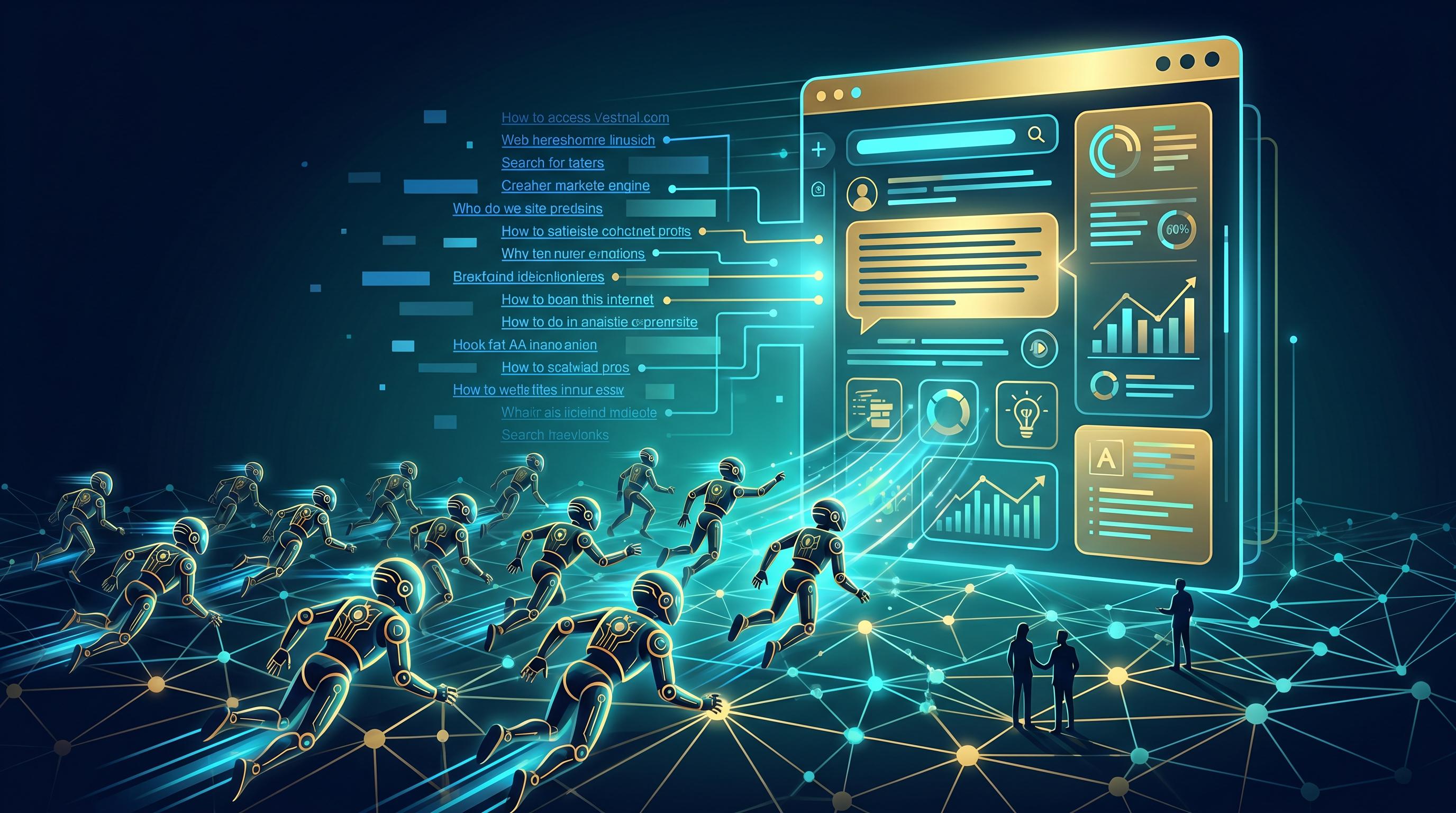
Here's a number that should stop you mid-scroll: according to Cloudflare's 2026 data, AI-driven bot traffic has overtaken human traffic on the web. CNBC reported in March 2026 that "AI and bots have officially taken over the internet." Cloudflare's CEO has projected that bot traffic will exceed human traffic entirely by 2027.
“Non-human traffic will exceed human traffic sometime in the first half of 2027”
This isn't a niche trend. It's a structural change to how the internet works. AI agents — autonomous software that browses, reads, summarises and acts on web content — now represent the largest category of "visitors" to most websites.
For anyone running a content programme, this changes everything about who you're writing for and how your content gets discovered.
The Crawl-to-Click Gap and Why It Matters for SEO
Cloudflare coined a useful concept: the "crawl-to-click gap." AI crawlers visit your pages at enormous scale, but they rarely click through, convert or behave like human users. They extract information, feed it to language models and move on.
Traditional SEO metrics — click-through rate, bounce rate, time on page — start to break down when a significant share of your traffic isn't human. You might see impressions rise while conversions flatline. Your analytics dashboard tells a story that no longer matches reality.
This gap forces a practical question: if AI agents consume your content but never convert, how do you measure the value of being crawled? And more importantly, how do you ensure the AI agents cite you rather than a competitor when they generate answers?
How AI Agents Change GEO
GEO — Generative Engine Optimisation — is the practice of structuring your content so that AI-powered search tools like ChatGPT, Perplexity and Google's AI Overviews cite it in their generated responses. It's the next layer on top of traditional SEO.
AI agents amplify the importance of GEO in three concrete ways:
1. Agents choose sources based on authority signals, not just rankings. An AI agent assembling an answer doesn't simply pick the top Google result. It evaluates E-E-A-T signals (Experience, Expertise, Authoritativeness, Trustworthiness), structured data, citation patterns and content depth. Thin content gets ignored entirely.
2. Agents synthesise — they don't link. When an AI agent answers a user's question, it may reference your insight without ever sending a click to your site. Your brand mention becomes the conversion event, not the pageview. That's a fundamental shift in how you define ROI from content.
3. Agents favour clear, direct answers. Content structured with specific claims, data points and semantically clear headings performs dramatically better in AI-generated citations. Vague thought leadership pieces get skipped. The data backs this up — a16z's research on GEO confirms that content with statistical evidence and direct-answer formatting earns significantly more AI citations.
Google's Search Overhaul Confirms the Shift
In May 2026, TechCrunch published a piece titled "Google Search as you know it is over." Google introduced AI agents directly into Search — tools that go beyond returning links and actively complete tasks on behalf of users.
This isn't speculation about a possible future. It's shipping product. Google's AI agents can now research topics, compare products and take actions across the web, all within the search interface. The traditional ten blue links are becoming a secondary interface.
For content strategists, this confirms two things. First, your content must be machine-readable and semantically structured — not just for Google's traditional crawler, but for its agent layer. Second, the definition of "ranking" is expanding. You're no longer competing for position one on a SERP (Search Engine Results Page). You're competing to be the source an agent trusts enough to cite.
What This Means for Your Content Strategy
If you're a marketing director or CMO watching your organic traffic plateau despite consistent publishing, agents are likely part of the explanation. Here's what to do about it.
Audit your content for agent-readability. Does your site use clean semantic HTML, proper heading hierarchy, structured data (JSON-LD) and clear topic definitions? AI agents rely on these signals far more than humans do.
Adopt a GEO-first editorial approach. For every piece you publish, ask: "If an AI agent reads this, will it find a clear, citable answer?" Structure your content with the answer at the top, supporting evidence below and semantically precise headings throughout.
Redefine your metrics. Track brand mentions in AI-generated answers alongside traditional traffic. Monitor your presence in tools like Perplexity, ChatGPT and Google AI Overviews. These are your new SERPs.
Invest in depth over volume. Cloudflare's crawl-to-click data shows that agents consume content at scale but only cite authoritative sources. Publishing three deeply researched articles per month will outperform thirty thin posts — in both human search and AI citation.
Build your E-E-A-T deliberately. Named authors with verifiable expertise, original data, cited sources and transparent methodology all increase the likelihood that agents select your content as a trusted source.
The Opportunity Inside the Disruption
Here's the part most people miss. Yes, AI agents disrupt traditional SEO. But they also create an entirely new channel for brand visibility and lead generation — if you structure your content to earn citations.
Brands that adapt early will compound their advantage. Content published today with strong GEO signals will continue generating AI citations for months and years. That's the same long-term compounding effect that made SEO valuable in the first place — just applied to a new discovery layer.
The brands that ignore this shift will watch their organic visibility erode while struggling to understand why "nothing changed" in their content strategy but results keep declining.
Something did change. The audience changed. Your most frequent visitor is now an agent, not a human. Write accordingly.