
The Internet Is Being Rebuilt for Machines — What It Means for SEO and GEO
Non-human traffic already accounts for 51% of all internet activity, and Cloudflare's CEO predicts it will dwarf human traffic by early 2027. If your content strategy still targets only human browsers, you're optimising for a shrinking audience.
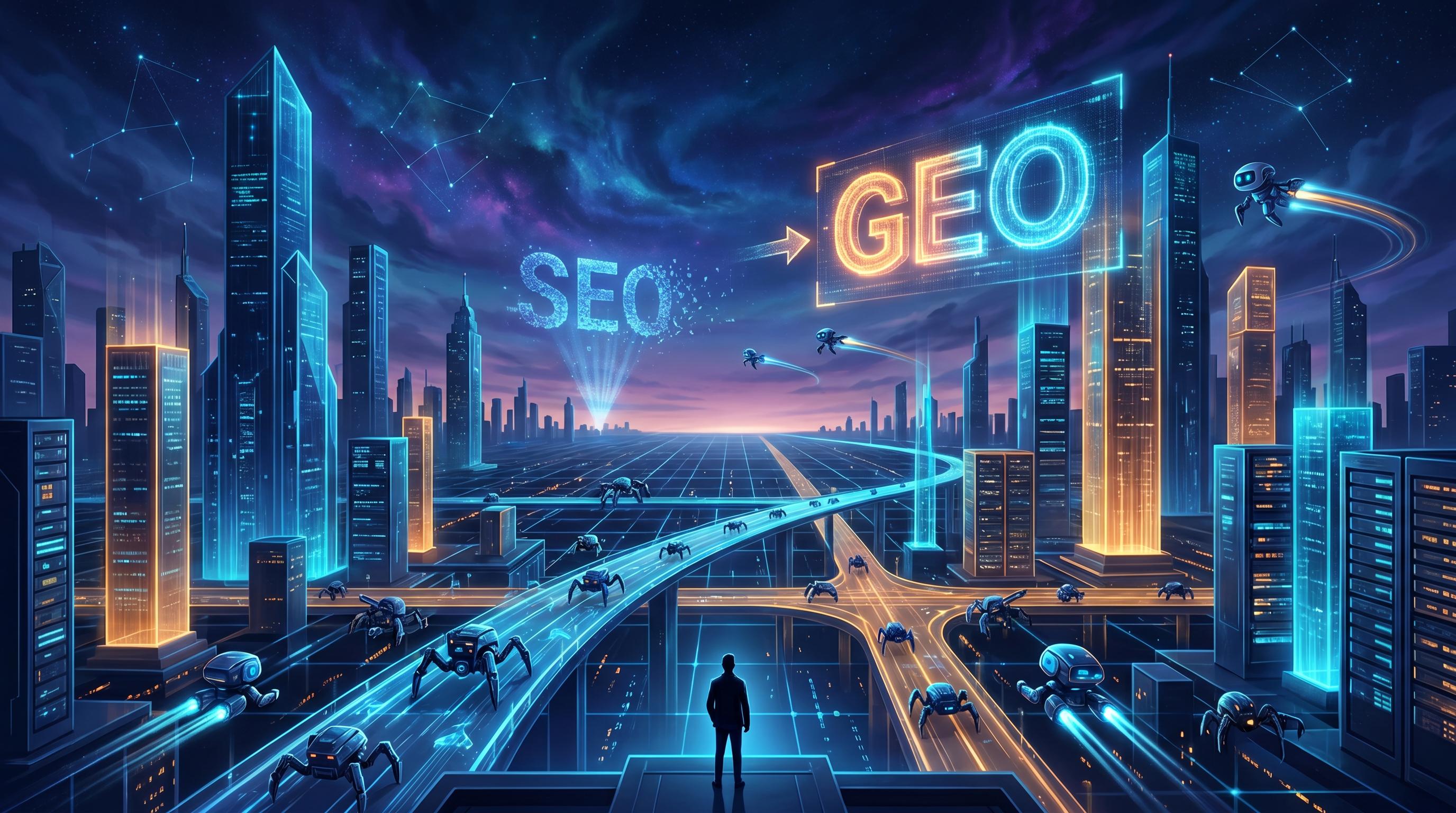
Machines now consume more of the internet than humans
Cloudflare's 2025 data confirmed what many suspected: automated bot traffic hit 51% of all internet requests, overtaking human traffic for the first time. Of that, AI-powered bots — crawlers from large language models, AI search engines and autonomous agents — grew fastest, with AI bot traffic surging roughly 31% year-on-year.
Non-human traffic will exceed human traffic sometime in the first half of 2027
— Cloudflare
The trajectory is clear. Cloudflare CEO Matthew Prince has stated publicly that non-human traffic will significantly exceed human traffic by the first half of 2027. TechCrunch reported in May 2026 that the internet is actively being "rebuilt for machines" — a structural shift, not a passing trend.
For anyone working in SEO — search engine optimisation — or content marketing, this isn't abstract. It changes what you optimise for, how you structure content and which channels actually drive results.
What does "rebuilt for machines" actually mean?
It means the internet's primary consumers are shifting from people using browsers to AI agents executing tasks. These agents don't browse. They query, extract, synthesise and act.
Think about how you already use AI search tools like ChatGPT, Perplexity or Google's AI Overviews. You ask a question. You get a synthesised answer with citations. You may never click through to the source.
Now multiply that behaviour across autonomous AI agents booking travel, comparing suppliers, drafting reports and making purchasing decisions on behalf of businesses. These agents need structured, trustworthy, machine-readable content to function. They don't care about your hero banner or your clever tagline.
Why traditional SEO alone won't cut it
Traditional SEO focuses on ranking in a list of ten blue links. That list is shrinking. Google's own AI Overviews now answer queries directly, often without a single click to your site.
If your entire strategy revolves around ranking position, you're fighting for a smaller prize. The real question isn't "Are we ranking?" It's "Are we being cited?"
This is where GEO — Generative Engine Optimisation — enters. GEO is the practice of structuring your content so AI-powered search engines and agents cite it as a trusted source. It's not a replacement for SEO. It's the next layer on top of it.
How GEO works in practice
GEO optimises for citation, not just clicks. Here's what that looks like:
Answer first, elaborate second. AI engines extract the clearest, most direct answer they can find. Put your key insight at the top of each section — not buried in paragraph four.
Use semantically clear headings. Your H2s should read like questions your audience actually asks. "What does rebuilt for machines mean?" beats "The Changing Landscape" every time.
Structure data for extraction. Use lists, tables, definitions and short paragraphs. AI crawlers parse structured content far more accurately than dense prose.
Build E-E-A-T signals. E-E-A-T — Experience, Expertise, Authoritativeness and Trustworthiness — is Google's quality framework, and AI search engines lean on similar trust signals. Named authors, cited sources, original data and concrete examples all strengthen your content's credibility for both human and machine readers.
Publish depth, not volume. A single 1,500-word article with original analysis and cited data points earns more AI citations than ten thin posts. Depth wins in a machine-first internet.
AI agents are your new audience — treat them like one
Most content strategies still assume a human reader sitting at a screen. That assumption is becoming less accurate by the quarter.
AI agents evaluating your brand don't read your About page and feel inspired. They extract structured data, cross-reference it with other sources and make decisions based on consistency, authority and clarity.
This means your content needs to serve two audiences simultaneously: the human decision-maker who still wants a compelling narrative and the AI agent that needs machine-readable, well-structured information to recommend you.
Brands that recognise this dual-audience reality early will compound their advantage. Those that wait will find their content invisible to the fastest-growing segment of internet traffic.
What you should do now
You don't need to rebuild your entire content programme overnight. But you do need to start adapting. Here's where to begin:
Audit your top 20 pages for GEO readiness. Do they answer questions directly? Are headings semantically clear? Is the content structured for extraction?
Add structured data. Schema markup (JSON-LD) helps both traditional search engines and AI crawlers understand your content's context. If you're not using it yet, start with Article and FAQ schema on your highest-traffic pages.
Monitor AI citation sources. Tools are emerging that track whether AI engines cite your content. Start paying attention to where your brand appears — and doesn't — in AI-generated answers.
Invest in content depth over content volume. One well-researched, expert-authored article per fortnight outperforms a daily stream of shallow posts. The maths on this are clear: depth compounds, volume dilutes.
Build your llms.txt file. This emerging standard helps AI crawlers understand which of your pages are most important and how your content is structured. Think of it as robots.txt for the AI era.
The bottom line
The internet is being rebuilt for machines. That's not a prediction — it's already happening. Over half of all web traffic is now non-human, AI bot traffic grew 31% last year alone and autonomous agents will only accelerate this shift.
Your content strategy needs to evolve accordingly. SEO remains essential — but it's no longer sufficient. GEO gives you the framework to ensure your content gets cited, not just indexed.
The brands that adapt now will own the AI-driven discovery layer. The ones that don't will wonder why their traffic is declining despite "doing everything right."